
Introduction
The CMO job changed when the reporting did. A marketing chief once answered for brand, campaigns and spend; the modern one is expected to answer for pipeline, and to do it with numbers drawn from a dozen systems that were never designed to agree with each other.
That is the real difficulty of the role today, and it is less glamorous than the job description suggests. Strategy is the visible part. The part that determines whether the strategy can be defended is whether the CMO can say which activity produced revenue — and in most organisations, the honest answer is assembled from several partial accounts supplied by the parties being evaluated. ## Key Takeaways
- The modern CMO answers for revenue contribution, not campaigns or brand alone
- Budget allocation and vendor accountability are the highest-leverage parts of the role
- Accountability requires performance data the vendors did not supply themselves
- Fractional models suit organisations needing judgment rather than daily leadership
- Whatever the model, the scoreboard should be independent of whoever executes
LexxlyIQ tracks the whole chain — marketing → lead → intake → signed case → revenue — so cost per signed case is a number the firm owns.
What Is a CMO in Digital Marketing?
A Chief Marketing Officer is the executive responsible for a company's marketing vision, brand direction, and — increasingly — its revenue outcomes. That last part is the shift worth paying attention to. The role used to center on advertising oversight. Now it centers on growth.
Three forces pushed the CMO job into this new territory:
- Channel proliferation — brands now manage SEO, paid social, email, CTV, and AI search visibility simultaneously, not just print and TV
- Customer expectations — buyers expect real-time, personalized experiences, which requires marketing to operate on the same data infrastructure as sales and product teams
- Cross-departmental demands — marketing decisions now touch IT, finance, and sales in ways that require the CMO to speak all three languages

This expanded scope hasn't made the job easier to hold onto. Spencer Stuart's 2024 CMO Tenure Study found that the average tenure for Fortune 500 CMOs sits at just 4.2 years — flat from the year before, but still shorter than nearly every other C-suite role. The job has grown faster than most executives can keep up.
CMO vs. Marketing Director vs. CDO: Who Does What?
Firm owners building a leadership team often blur these three titles. The differences matter:
| Role | Organizational Position | Core Focus |
|---|---|---|
| CMO | C-suite executive | Sets marketing vision, owns the budget, and is accountable for revenue growth through marketing |
| Marketing Director | Reports to the CMO | Manages day-to-day campaign execution, team output, and channel performance |
| CDO | Senior digital transformation leader | Owns technology infrastructure and organization-wide digital change, sometimes including customer-facing digital experience |
The CMO-Director distinction is mostly about authority, not tasks — the two roles often overlap on the ground. The CMO-CDO line is different. A CDO typically owns the systems behind digital transformation, while a CMO owns how customers experience the brand. The two increasingly partner, especially on data infrastructure and personalization.
At most law firms, the lines blur further. Headcount and budget rarely support three separate seats, so one leader — a full-time hire or a fractional executive — often covers vision, execution, and digital infrastructure together. ## Key Responsibilities of a Modern Digital CMO
Strip away the buzzwords and a digital-era CMO is responsible for six connected jobs:
- Building omnichannel strategy: keeping brand messaging consistent across web, social, paid, and email
- Making evidence-based decisions: using analytics platforms, not gut instinct, to guide budget and creative choices
- Owning the customer experience: from first ad impression through post-sale engagement, not just the top of the funnel
- Managing budgets and vendors: leading internal teams while holding agencies to measurable results, not activity reports
- Evaluating new technology: weighing AI tools, marketing automation, and personalization engines as they mature
- Tying marketing to revenue: working with sales and finance so every campaign maps to a business outcome
That data-driven mandate isn't theoretical. Martech now consumes 19.9% of the average marketing budget in the U.S., according to the Spring 2024 CMO Survey, with leaders expecting that share to climb toward 30% within five years. The CMO who can't read a dashboard is quickly becoming the CMO who's out of a job.
Vendor accountability deserves its own mention here, because it is the responsibility most often claimed and least often practised. In substance it means monthly scorecards built around signed cases and cost per consultation rather than clicks or impressions — and, critically, scorecards drawn from data the vendor did not supply. A vendor grading itself is not accountability; it is reporting.

The Part That Decides Whether It Works
Marketing leadership only pays off if someone can tell whether it did. That sounds obvious; in practice it is where most engagements quietly fail. A capable leader arrives, tidies the vendor roster, rebuilds the site, launches a content plan — and twelve months later the firm cannot say whether cost per signed case moved, because nobody established the baseline before the work started.
The chain a law firm needs visibility into runs:
marketing → lead → qualified lead → intake contact → signed case → revenue
Vendors report on the first link, because it is the only one they can see. Case management holds the last two. The qualification and intake steps in the middle are usually where matters are lost, and usually where no one is looking.
Three things are worth insisting on before any engagement begins:
- A baseline. Cost per signed case by source for the last four quarters. Without it, every later claim of improvement is unfalsifiable. - Data the firm owns. Analytics, call tracking and attribution history in accounts under the firm's control, so the record survives a change of leadership or vendor. - A review date and a metric. Agreed in advance, in case economics rather than activity.
This is the layer LEXGRO occupies. It delivers no SEO, PPC, content or web design, and instead measures what the firm's existing team and vendors produce — LexxlyIQ joins CRM, call tracking, advertising and intake data so cost per signed case by source is a number the firm owns rather than one a vendor reports. The point is not more dashboards. A dashboard displays numbers; the work is connecting them, finding the leak and saying what to do about it. ## Skills Every Digital-Age CMO Needs
Not every marketer can step into this role. The ones who succeed tend to share four traits:
- Digital channel fluency — working knowledge of SEO, paid advertising, content, social, and marketing automation platforms, even if they don't execute the work personally
- Leadership and communication — the ability to align sales, IT, and creative teams around one strategy and translate it into execution
- Data literacy — reading analytics and converting insights into specific budget or campaign decisions, not just reporting numbers upward
- Adaptability — a willingness to evaluate and adopt new tools as the landscape shifts, rather than defending what worked five years ago
None of these skills exist in isolation. A CMO with strong data literacy but no leadership ability can't get a team to act on insights. One with channel fluency but no adaptability will optimize yesterday's playbook while competitors move on. ## Full-Time CMO vs. fractional marketing leader: Which Model Fits Your Business?
Full-time CMOs fit businesses with large, complex marketing operations: multiple brands, multiple markets, and budgets that justify a dedicated executive salary.
The U.S. Bureau of Labor Statistics puts the median annual wage for marketing managers at $161,030 as of May 2024. Benefits, bonuses, and overhead routinely push a full CMO hire past $300,000 a year.
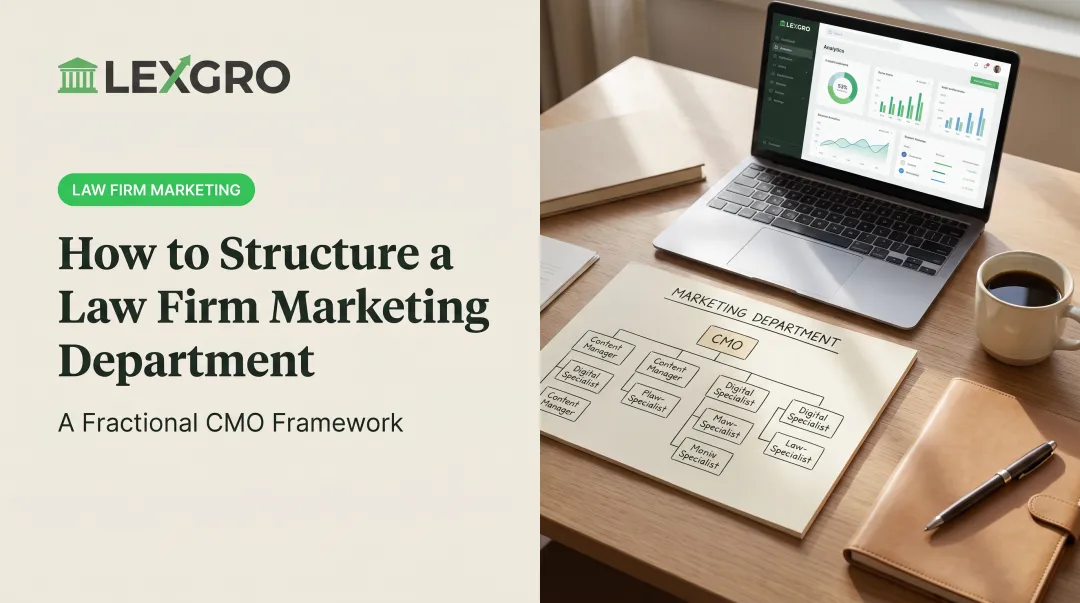
Most growing businesses aren't there yet. That's where a fractional (or virtual) CMO comes in: senior-level strategic marketing leadership delivered part-time or on a project basis, at a fraction of the full-time cost.
Why This Model Fits Law Firms Specifically
Law firms rarely need — or can justify — a full-time marketing executive. But they still need someone accountable for turning ad spend into signed cases. A fractional marketing leader fills that gap:
- Delivers strategy, vendor oversight, and performance reporting without a six-figure salary
- Unifies direction for firms already spending $30,000+ per month on marketing
- Replaces five disconnected vendors with one accountable leader for founder-led firms
For law firms, LEXGRO provides the measurement half of this picture: founded by Keith Dyer after 25 years of legal marketing experience across 100+ law firm partnerships, it delivers no SEO, PPC or web work itself and instead supplies the independent scorecard — qualified leads, intake conversion, signed cases and cost per signed case by source.
A Simple Decision Framework
Ask these four questions:
- What's your growth stage? Firms scaling toward $10M+ in revenue or adding offices often need more bandwidth than a part-time engagement provides. 2. What's your marketing budget? Under $5,000/month, a fractional model may be premature; above $30,000/month, it's often essential. 3. How many channels are you running? Three or more vendors (SEO, PPC, web, content) without a unified strategy is a clear signal. 4. Do you need legal-industry specialization? Generalist CMOs often miss practice-area nuances—SEO rarely pays off in referral-driven M&A or IP, but it works well for personal injury and personal injury.

Where the Role Is Heading
Two shifts are reshaping what the job requires, and they pull in the same direction.
AI is absorbing the execution layer. Creative production, media buying and reporting are increasingly automated, which lowers the value of overseeing execution and raises the value of deciding what should be executed. Judgment about allocation becomes the scarce input.
Attribution is getting harder, not easier. Privacy changes, cookie deprecation and AI-mediated search are eroding the tracking that made the last decade's dashboards possible. More of the customer journey now happens where no pixel fires.
Those two together produce an uncomfortable conclusion for anyone holding the role. The CMO will be asked to justify spend with steadily less platform-level evidence — which makes first-party data, clean CRM records and outcome tracking the assets that matter, and makes any metric supplied solely by a channel vendor progressively less defensible. ## Frequently Asked Questions
Is CMO higher than Marketing Director?
Yes. The CMO is the senior C-suite executive who sets marketing strategy, vision, and budget. The Marketing Director typically reports to the CMO and manages day-to-day execution and teams.
What does CMO stand for in digital marketing?
CMO stands for Chief Marketing Officer. In digital marketing, the role now covers data strategy, technology adoption, and customer experience—not only traditional advertising.
What is the difference between a CMO and a fractional marketing leader?
A fractional marketing leader delivers the same strategic leadership as a full-time CMO but on a part-time or contract basis, often serving several businesses at once rather than one employer exclusively.
Do small businesses or law firms need a CMO?
Not every small firm needs a full-time CMO, but most benefit from CMO-level strategic guidance. A fractional model is usually the most practical way to access it.
How much does hiring a CMO typically cost compared to a fractional marketing leader?
A full-time CMO is a major fixed cost, often exceeding $300,000 annually with salary and benefits included. fractional marketing leader arrangements offer senior expertise at a lower, flexible investment. Exact costs vary by market and scope.
What skills should a modern digital marketing CMO have?
A modern digital marketing CMO needs digital channel fluency, data literacy, clear leadership and communication, and the ability to adapt as tools and platforms change.