Introduction
Every sales call holds evidence: lead quality, rep behavior, customer objections, whether a next step actually got confirmed. Most managers never hear it.
In one industry survey, 44% of contact centers monitored just 1% to 3% of inbound calls for quality, and the share was similar for outbound calls. That means the vast majority of conversations go unreviewed (ICMI, 2019).
AI call scoring changes that math. It evaluates recorded sales conversations against defined criteria, replacing gut-feel spot checks with consistent, repeatable analysis.
This article breaks down how the process works, what it measures, how scores translate into coaching, and how US sales teams, including law firms, can put the insights to use responsibly.
Key Takeaways
- AI call scoring turns call audio into structured data through capture, transcription, scorecards, and AI analysis.
- Criteria quality drives score quality, so define measurable behaviors, not vague goals.
- Every eligible call can get AI review; managers still own context, calibration, and coaching decisions.
- Call scoring evaluates conversations; lead scoring ranks prospects. They answer different questions.
- Tie scores to specific coaching actions and business outcomes to make them useful.
What Is AI Call Scoring for Sales?
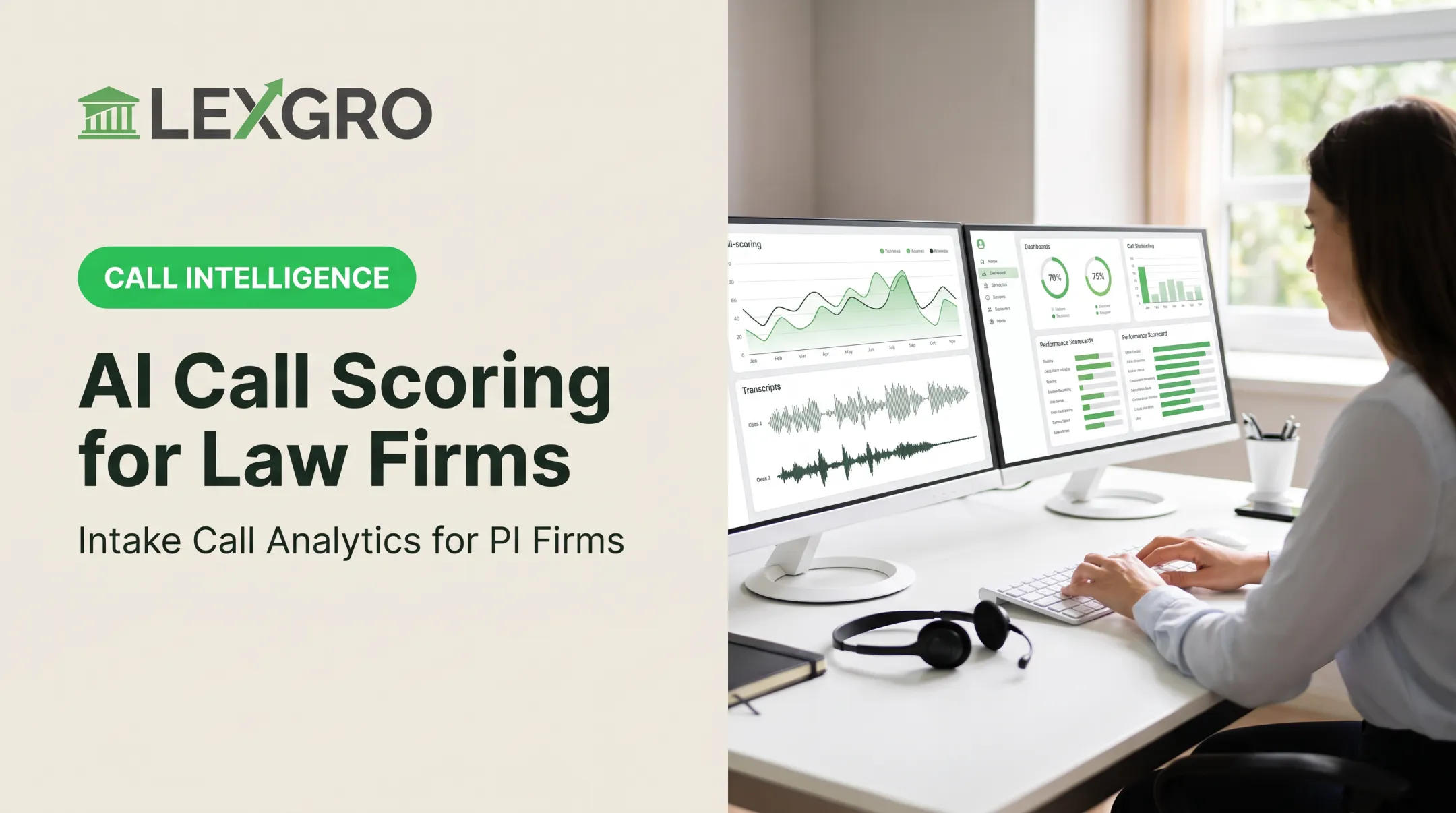
AI call scoring is the automated evaluation of sales conversations using speech recognition, transcription, natural language processing, and a configurable scorecard. Instead of a manager listening live or sampling a handful of recordings, the system reviews calls against a defined rubric and produces a score with supporting evidence.
The problem it solves is simple math: managers can't listen to everything. Manual reviews also vary from one reviewer to the next. A small sample easily misses recurring patterns—for example, a rep who always skips discovery questions, or one who never confirms next steps.
AI call scoring is not the same as:
- Call recording — recording stores the conversation; scoring interprets it against criteria.
- Lead scoring — lead scoring ranks prospects by fit or intent; call scoring rates the conversation itself.
- Revenue intelligence — broader platforms combine call data with pipeline, email, and CRM signals; call scoring is one input into that picture.
Most platforms use one of three approaches:
- Rules-based scoring checks required phrases, disclosures, or process steps with keyword matching.
- Generative or semantic scoring judges context-heavy criteria like discovery quality or empathy, where no single phrase is "correct."
- Hybrid scoring blends both: deterministic checks for strict requirements, contextual analysis for nuanced behavior.
Scorecard design decides whether teams trust the output. Vague criteria, weak weighting, or unclear thresholds for escalating a call to human review produce scores nobody uses.

How Does AI Call Scoring Work?
The process is a sequence, not a single step. It turns a conversation into a score, an explanation, and ideally, a coaching opportunity.
Call Capture and Data Preparation
The system first needs the raw material: recordings or live audio from a phone system, dialer, meeting platform, or call-recording repository. Several things affect what happens next:
- Speaker identification, separating rep speech from prospect speech
- Audio quality and background noise levels
- Language support and accent handling
- Timestamps and call metadata
- Permission to record
That last point matters more than it might seem. Recording consent laws vary by state. Most US states allow one-party consent, meaning only one person on the call needs to agree to recording, but a smaller group of states require all parties' consent, and interstate calls can complicate which rule applies (Justia, 2024).
Sales and intake teams should confirm their recording, retention, and access-control practices with qualified counsel rather than assuming one state's rule applies everywhere.
Transcription and Conversation Segmentation
Automatic speech recognition converts audio into a searchable transcript and separates who said what. Timestamps and segments let the system flag discovery questions, objections, pricing talk, commitments, silence, interruptions, and closing language.
Transcripts aren't perfect, though. A 2025 study testing six open-source speech recognition systems across conversational datasets found word error rates ranging widely, from roughly 0.17 to nearly 2.0 depending on the dataset and conditions, with overlapping speech causing significant degradation for some systems but not others (ACL Anthology, 2025).
Accents, industry jargon, cross-talk, and poor audio all affect accuracy. Treat the transcript as a strong starting point, not an infallible record.
Scorecard Configuration
This is where a sales methodology becomes something the AI can actually check. A general sales team might score:
- Did the rep establish an agenda?
- Did they ask qualifying questions?
- Did they uncover the prospect's actual problem?
- Did they address objections directly?
- Did they confirm a specific next step?
A law firm's intake or consultation workflow needs different questions: responsiveness, matter-type qualification, expectation setting, consultation scheduling, and an accurate handoff to the attorney. LEXGRO's intake framework, for instance, recommends consultations confirm client fit, build confidence in the firm's specific expertise, and make the next step explicit and easy to act on.
Good scorecards mix question types:
- Binary checks — did the rep ask about budget, yes or no?
- Rating scales — how well did the rep handle the pricing objection, on a 1-5 scale?
- Count-based measures — how many open-ended discovery questions were asked?
- Outcome criteria — did the call end with a scheduled next step?
Avoid criteria like "sound more persuasive." It's not measurable and the AI has nothing concrete to check. Start with a focused scorecard, validate it against calls you've already reviewed manually, and revise any question that produces inconsistent or unhelpful scores.
AI Evaluation and Score Generation
Once the scorecard exists, the AI compares the transcript and call signals against each question, looking for evidence rather than forming one vague overall impression. Gong's documentation describes scorecards supporting yes/no, multi-select, open-ended, and numeric-range questions, with weights that typically total 100% across a scorecard (Gong, 2026).
Typical outputs include:
- Pass/fail checks on required steps
- Weighted category scores
- Highlighted moments with timestamps
- Call summaries and sentiment signals
- Talk-to-listen ratios
- Flagged calls recommended for human review
A good system shows its work, pointing to the exact timestamp or excerpt behind a score. Without that evidence, a manager can't verify the result or discuss it productively with the rep.
Vendor documentation also notes that AI tends to be more reliable on fact-based questions (did the rep mention pricing?) than subjective ones (was the rep empathetic?). That is why manual scorers need the ability to override a suggested answer.
Human Review, Coaching, and Continuous Calibration
Scores aren't the finish line. Managers still review low-scoring or high-stakes calls, confirm the AI interpreted the conversation correctly, and add context a transcript can't capture, such as tone, relationship history, and prior conversations.
A score becomes a coaching plan like this:
- Identify one specific behavior to improve
- Replay the exact moment from the call
- Agree on a better approach together
- Practice the alternative in a role-play
- Track that same criterion on future calls
Calibration is ongoing, not a one-time setup. It means updating the scorecard as scripts or services change, periodically comparing human and AI scores on the same calls, and watching for drift after regulatory or market shifts.
COPC's quality assurance research notes that procedural items (greetings, disclosures) are easier for AI to score reliably than outcomes like customer trust or satisfaction. A high process score doesn't automatically mean a good customer experience.
Tying scores to outcomes like qualified opportunities, consultation bookings, or signed cases is what keeps the whole system honest.

Where AI Call Scoring Is Used
Scoring applies differently depending on where a call sits in the sales process.
- Prospecting and first contact: opening clarity, relevance, permission to continue, early qualification
- Discovery or consultation calls: question quality, listening, problem identification, next-step agreement
- Objection handling and closing: whether concerns were acknowledged, value explained accurately, and a concrete follow-up secured
- Follow-up and intake: commitments documented, handoffs completed, accurate information delivered
For law firms specifically, AI scoring can check intake consistency, response quality, consultation scheduling, and appropriate escalation, without ever touching legal advice itself.
One useful guardrail is flagging whether intake staff avoid making promises about case outcomes. California's Rule of Professional Conduct 7.1 prohibits communications that guarantee a particular result, and that standard extends to anyone communicating on a lawyer's behalf, including intake staff on a call.
Responsiveness is worth scoring too. Clio's 2024 secret-shopper study of 500 law firms found only 40% answered a prospective client's call live, and 52% either answered or eventually called back. Roughly half of callers went unreached by phone. That's a measurable, coachable gap.

Real-time versus post-call scoring
Real-time assistance can surface an approved reminder mid-call, a disclosure the rep forgot, or a question they skipped. Post-call scoring is better suited to detailed evaluation, trend analysis, and scorecard calibration.
Teams should balance real-time prompting against natural conversation flow, privacy obligations, and room for reps to use their own judgment.
LEXGRO's intake performance work follows this pattern: calls are recorded with permission, graded against a defined rubric, and fed into the LexxlyIQ module. Firms can see exactly where potential cases are getting lost, whether that's a missed qualifying question or a next step that never got confirmed.
Conclusion
AI call scoring captures conversations, transcribes them, scores them against a defined scorecard, and turns the findings into coaching evidence managers can use. It does not replace a sales manager or shrink a conversation to a single number.
The point is better evidence for improving rep behavior and the customer experience that follows. LEXGRO applies that same measurement discipline to law firm intake, treating call grading as part of a repeatable growth system rather than a one-off audit.
Evaluate any AI call-scoring platform, including the tools behind LEXGRO's intake grading, on:
- Fit with your existing workflow
- Privacy and compliance safeguards
- Integration with CRM and call tracking
- Whether it improves coaching quality and conversion outcomes
Frequently Asked Questions
How does AI call scoring for sales work?
The system captures a recorded call, transcribes it, and compares the transcript against a scorecard of defined questions. AI generates findings with supporting evidence, and managers use that evidence to coach reps.
How can sales teams practice and coach sales calls using AI?
Teams pull scored excerpts showing specific skill gaps, assign targeted role-play around that exact moment, and review the improved attempt. Tracking the same criterion across later calls shows whether the behavior actually changed.
What is a sales lead scoring system?
Lead scoring ranks prospects by their likelihood of becoming customers, using fit, intent, engagement, or behavioral data. It evaluates the prospect, not the conversation, which is what separates it from call scoring.
What is a QA score in a call center?
A QA score rates a single interaction against a rubric covering compliance, process adherence, communication quality, and resolution. It reflects the rubric chosen, not an automatic measure of customer satisfaction.
What should an AI sales call scorecard measure?
Strong scorecards measure discovery quality, qualification, objection handling, accuracy of claims, listening behavior, next-step confirmation, and compliance. Criteria should be specific and measurable, tailored to the actual sales motion.
Can AI call scoring replace human sales managers?
No. AI expands coverage and surfaces evidence from calls managers would never otherwise hear, but managers are still needed for context, calibration, coaching conversations, and decisions with ethical or legal weight.