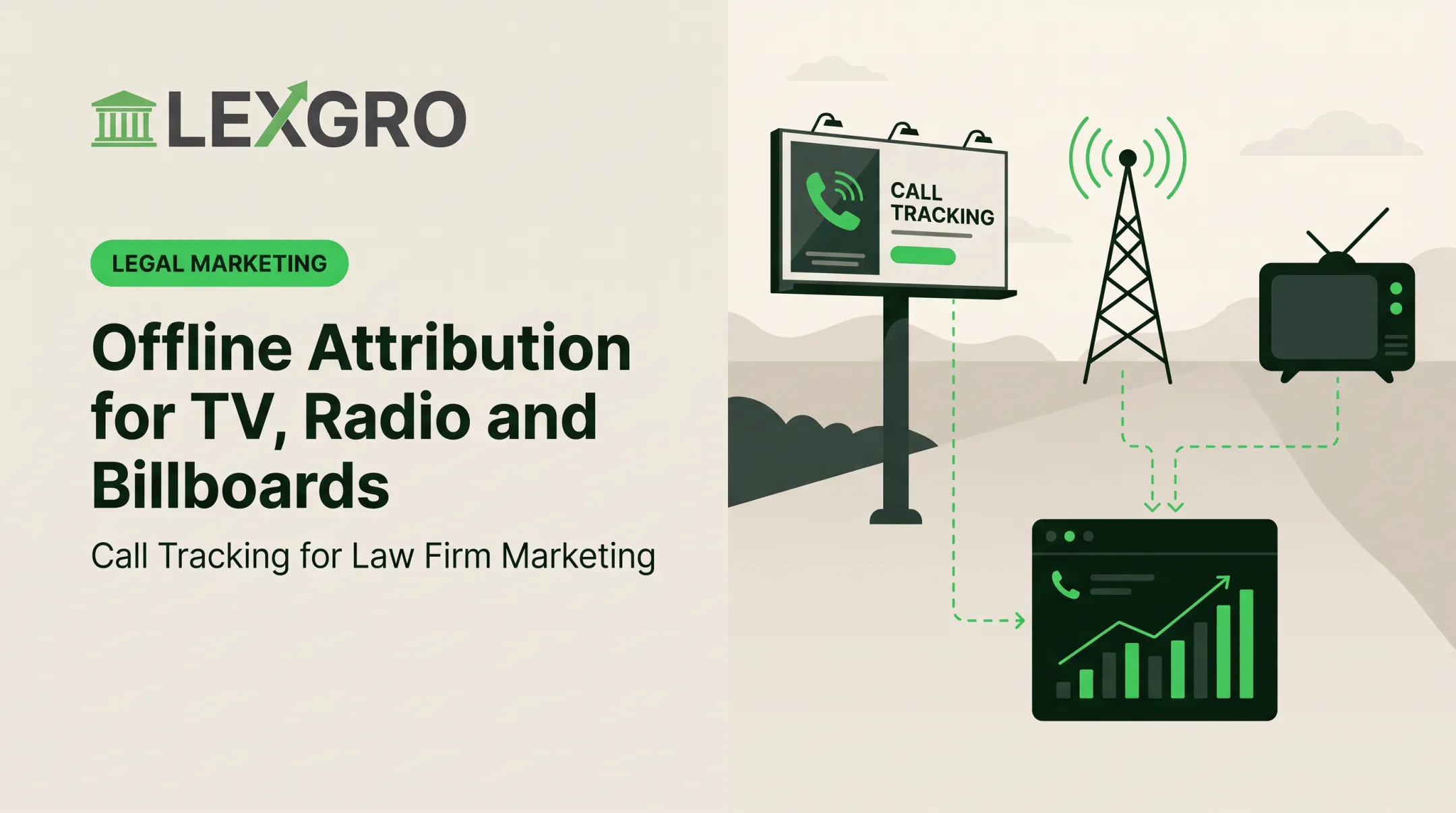
Marketers are still figuring this out. Only 50% of surveyed global marketers felt very or extremely confident measuring connected TV ROI, according to Nielsen's 2023 report. That's confidence, not proof — and it's a gap worth closing.
TV attribution is the framework that closes it. It connects ad exposure to measurable actions: branded searches, website visits, calls, consultation requests, and ultimately, revenue. This article walks through what it is, why it matters, and how to build a measurement process that holds up to scrutiny.
Key Takeaways
- TV attribution measures and assigns credit for actions that follow a TV or CTV ad exposure
- Baselines, conversion lag, and incrementality matter more than raw reach
- Trustworthy results depend on clean airing data, quality first-party data, and privacy-safe matching
- Findings should guide creative, daypart, placement, budget, and linear-vs-CTV decisions
What Is TV Attribution?
TV attribution is the process of measuring how a TV ad exposure contributes to what happens next: a search, a site visit, a call, a signed client.
It's easy to blur four related terms:
- Exposure: who may have seen or been served the ad
- Response: the activity that follows an airing, like a search spike or site traffic
- Attribution: assigning credit for that response to a specific touchpoint or campaign
- Incrementality: estimating the additional outcome the ad caused, compared with what would have happened anyway
This matters across the entire funnel. Awareness campaigns, consideration-stage retargeting, lead generation, and even offline store or office visits can all be measured, in theory. In practice, the measurement environment changes the data you get.
Linear vs. CTV vs. Cross-Device
Linear TV relies heavily on scheduled spot data and panel-based audience estimates. Connected TV can offer more granular, household-level signals, but those signals are still bound by platform access and privacy rules, per the IAB's measurement guide.
Cross-device measurement attempts to stitch a TV exposure to a later action on a phone or laptop, which is harder than it sounds given how few identifiers carry over.
Attribution models also answer different questions. First-touch and last-touch models are simple but incomplete. Multi-touch models spread credit across several touchpoints. Uplift testing and marketing mix modeling isolate incremental impact rather than just crediting activity.
LEXGRO's LexxlyIQ module applies this last idea directly: in its multi-touch model, CTV typically builds awareness, SEO builds trust over repeated visits, and PPC captures the final intent to convert. CTV rarely wins last-click credit, but that doesn't mean it didn't do the work.

Why TV Attribution Is Critical for Measuring Ad Impact
Seeing that your audience was exposed to an ad is not the same as proving the campaign caused a business result. Attribution gets you closer to that proof, but it's an estimate, not automatic causation.
Good measurement sharpens decisions. You can compare performance by:
- Network and daypart
- Creative version and spot position
- Audience segment and geography
- Device type and campaign period
None of that comparison means anything without a baseline. Baseline and counterfactual analysis normalizes for seasonality, existing demand, concurrent paid media, email sends, and news events: all the things that generate activity whether or not your TV spot aired.
What You Can Actually Connect to TV Exposure
- Brand and non-brand search volume
- Website sessions, landing page engagement, form submissions
- Calls, booked consultations, and qualified leads
- Signed matters, revenue, and return on ad spend
Skip the baseline work, and you're exposed to real risks: recall bias from surveys, delayed conversions that never get matched back, duplicate credit across channels, and mistaking correlation for incremental lift.
This isn't hypothetical. A CIMM study examined 11 TV attribution providers and found divergent lift magnitude and direction, largely because of inconsistent exposure data and processing methods, not the campaigns themselves.
Separately, a peer-reviewed field test on TV advertising found immediate sales increases that coexisted with activity simply shifting forward from later periods, rather than new demand. In other words, a short measurement window can make a campaign look more effective than it actually was.
Internally, LEXGRO has seen the cost of skipping this step firsthand: 60% of personal injury marketing budgets get wasted without proper tracking in place. That's not a TV-specific number, but it illustrates why measurement discipline matters before you scale spend.

How TV Attribution Works — Step by Step
Most attribution breaks down for a handful of recurring reasons: incomplete airing logs, fuzzy conversion definitions, weak baselines, untracked offline outcomes, and skipping validation entirely. Here's a workflow that avoids those traps.
Step 1 – Define the Objective and KPIs
Decide what question you're answering before you touch any data. Are you measuring awareness, immediate response, leads, signed clients, or incremental lift?
For a law firm, branded searches and consultation requests are useful leading indicators. But qualified cases, signed matters, and revenue are the outcomes that actually matter. Align the two before the campaign launches.
Step 2 – Gather and Standardize Inputs
Pull together:
- TV spot date, time, channel, program, creative, duration, and placement
- Spend, reach, and impression data by market
- Website analytics, search data, call tracking, CRM records, and transaction data
Data governance matters here. Consistent timestamps, deduplication, geographic alignment, and privacy-safe matching determine whether your later analysis means anything.
Step 3 – Prepare the Data and Set the Attribution Window
Clean the inputs and flag activity likely driven by other channels: email sends, paid search, social, radio. Then set a reasonable response window.
Immediate search or site activity might need a short window of a day or two. Consultations, purchases, or signed matters often take weeks. Test multiple windows rather than assuming one fits every outcome.
Step 4 – Estimate the Baseline or Counterfactual
The baseline estimates what would have happened without the TV ad. A simple moving average is better than nothing, but it misses seasonality, concurrent media, and one-off events.
More robust methods such as time-series modeling, geographic holdouts, and matched control groups account for those factors. Baseline quality is what separates a credible uplift estimate from a coincidence.
Step 5 – Calculate Uplift, Assign Credit, and Validate
Compare observed activity against your baseline. Check whether the difference holds up consistently across spots, audiences, markets, and time periods, not just in one lucky week.
Validate with:
- Holdout regions or matched markets
- Conversion-lag analysis
- CRM reconciliation and duplicate removal
- Comparison against non-TV channels running at the same time
Step 6 – Interpret Results and Optimize
Turn findings into decisions: budget shifts, frequency changes, creative swaps, network or daypart adjustments, or rebalancing linear versus CTV spend.

Example walkthrough: A CTV campaign generates 50,000 impressions in a market. Branded search traffic spikes within 48 hours. Site analytics show CTV as the first touch on three conversions, even though none of them clicked the ad directly. They searched for the firm later and converted through organic or paid search.
Without view-through tracking, CTV would get zero credit for work it actually did. That blind spot is what LexxlyIQ's view-through tracking is built to catch: people who saw a CTV ad even when their next action happened somewhere else entirely.
How LEXGRO Can Help
LEXGRO isn't a TV attribution platform. It's a fractional CMO partner for US law firms that need marketing activity connected to intake, case growth, and revenue, whatever channels make up the media mix.
That distinction matters. Rather than selling a proprietary measurement black box, LEXGRO helps firms build the framework around their existing tools:
- Setting campaign objectives and KPIs before spend goes out the door
- Establishing call and form tracking with consistent source data
- Coordinating lead qualification through to signed matters and revenue reporting
- Working alongside a firm's existing media, analytics, CRM, or technology vendors rather than replacing them
The LexxlyIQ platform pulls CRM, call-tracking, ad-platform, and intake data into one view. A firm can see cost per lead, cost per consultation, and cost per signed case across channels, not just impressions.
Founder Keith Dyer brings 25 years of legal marketing experience to this work. He's partnered with more than 100 law firm partners, managed millions in marketing spend, and helped generate over $75 million in client revenue. That track record spans the full marketing mix, not TV campaigns exclusively. No measurement framework guarantees a specific result. What it does is make sure every dollar gets tracked back to something real.
Conclusion
TV attribution connects exposure to response, and response to business outcomes. But that connection only holds up with accurate airing data, a credible baseline, realistic conversion windows, and privacy-safe matching behind it.
One campaign report isn't the final word. Treat attribution as an ongoing practice : something you revisit to refine creative, adjust media allocation, tighten intake tracking, and inform the next growth decision, rather than a one-time verdict on whether TV "worked."
Frequently Asked Questions
What is a good CPM for TV?
There's no universal benchmark. A good CPM depends on audience quality, market, inventory type, and campaign objective. Evaluate it alongside outcomes like qualified leads or revenue, not in isolation.
How do you measure attribution?
Combine exposure data with post-exposure activity, compare against a baseline or control group, and match conversions within a defined attribution window. Remember: attribution estimates contribution, not guaranteed causation.
How do TV channels know how many people are watching?
Viewership estimates come from a mix of audience panels, set-top-box or device data, streaming platform logs, and statistical modeling. Methodologies vary by provider, so reported viewership is always an estimate.
What does attribution mean in media?
Attribution means assigning some or all credit for a conversion to one or more marketing touchpoints. The model you choose (first-touch, last-touch, multi-touch) determines how that credit gets distributed.
What is an example of TV advertising?
A law firm runs a commercial on linear TV or CTV, then tracks subsequent branded searches, website visits, phone calls, and consultation requests to gauge the ad's downstream effect.
How much of a 30-minute TV show is commercial?
There's no fixed percentage. Commercial time varies by broadcaster, format, and platform. Children's programming has specific FCC hourly limits, but general programming does not follow one universal rule.