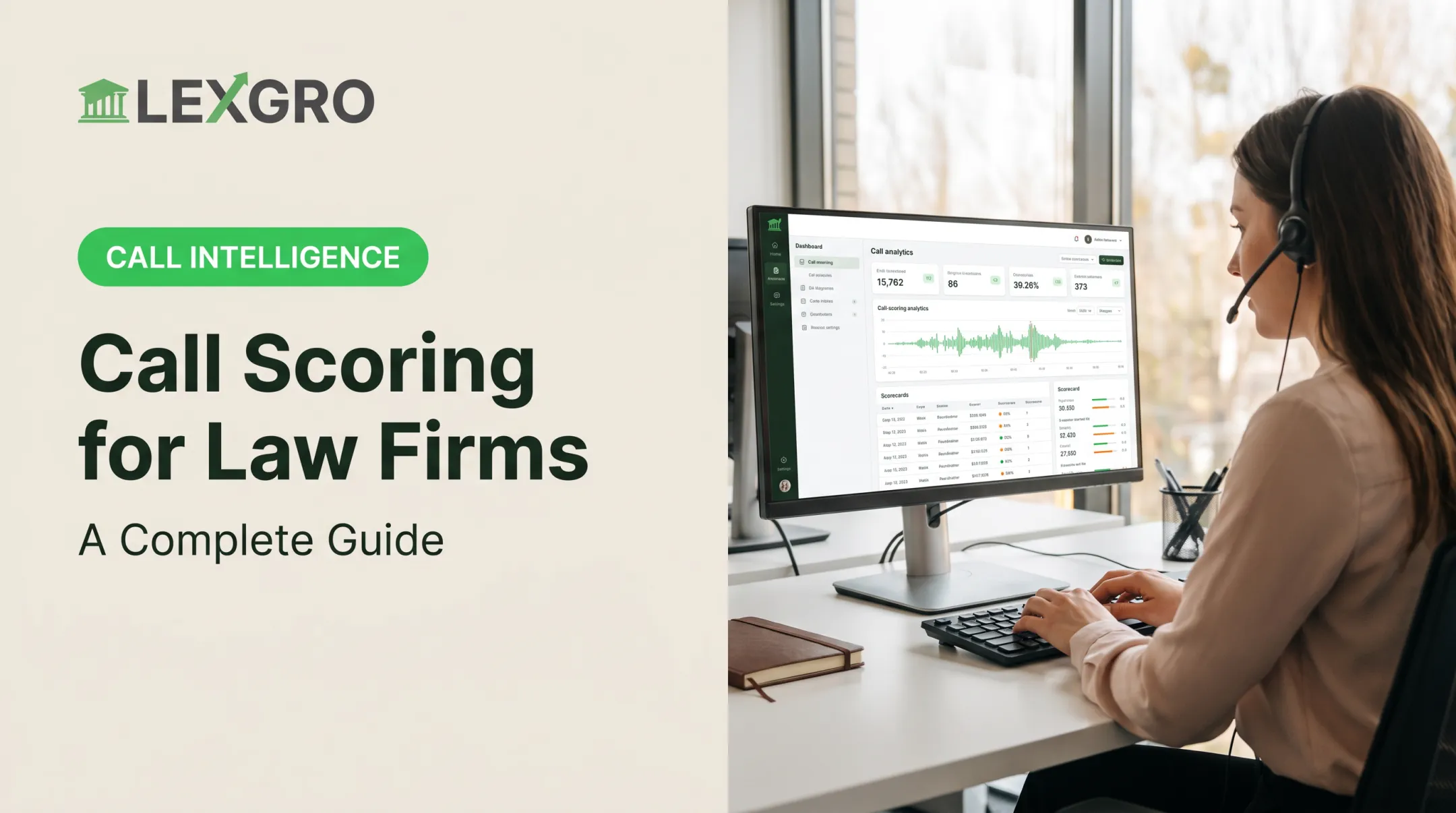
Most firms treat them all the same anyway. The result: the average law firm loses 40 to 60% of potential cases without realizing it, simply because nobody built a system to tell the hot leads from the noise.
Lead scoring fixes this. It ranks prospects using observable fit and engagement signals, so your intake team, marketing team, and attorneys know exactly who to call first, who needs partner review, and who can wait for a nurture sequence.
This guide breaks down a law-firm-specific scoring framework: matter fit, jurisdiction, urgency, engagement signals, intake readiness, negative scoring, routing, and the review process that keeps it accurate over time.
Key Takeaways
- Build scoring criteria around your firm's actual ideal client and matter profile, not generic marketing templates
- Combine fit signals (practice area, jurisdiction) with intent signals (consultation requests, repeat visits, calls)
- Use negative scoring to filter noise, but never let a score replace conflicts checks or attorney judgment
- Tie every score range to a specific next action, from same-day callback to disqualification
- Recalibrate quarterly using real consultation, retention, and matter-value data
What Is Lead Scoring for Law Firms?
Lead scoring assigns relative values to prospective clients, referral sources, or business development contacts based on how well they fit your practice and how much interest they've shown. It's a prioritization tool, not a decision-making tool.
That distinction matters. Salesforce draws a clear line between the two concepts: scoring ranks leads numerically, while qualification assesses fit, finances, and genuine need. A high score tells your team "call this person first." It doesn't tell you whether you can legally or practically take the case.
Why Generic Models Don't Work for Law Firms
A SaaS company can score every demo request the same way. Law firms can't, because the inputs are different:
- Practice-area fit varies case by case, not just by industry vertical
- Jurisdiction and bar admission create hard boundaries other industries don't face
- Conflict risk can disqualify an otherwise perfect lead overnight
- Matter urgency (a statute of limitations, an active arrest) can outweigh everything else
Consumer Intake vs. B2B Business Development
Personal injury, family law, criminal defense, and immigration firms mostly score individual consumer inquiries arriving through web forms, calls, and chat. Corporate and transactional firms score something closer to B2B pipeline: target accounts, existing clients, dormant relationships, and referral sources.
The LSSO framework for corporate legal business development proposes four qualifying conditions:
- An acknowledged problem
- A 60-to-120-day action timeline
- Willingness to consider the firm
- An internal champion willing to introduce other stakeholders
A friendly contact without that last piece is still a conversation, not a qualified opportunity.
Lead Scoring Criteria Law Firms Should Evaluate
Start with your own data, not a template. Pull records from retained matters, qualified consultations, declined matters, and dead opportunities. Patterns will emerge fast.
Practice-Area Fit
Weight inquiries higher when they match a service line you actively staff and market. Treat out-of-scope matters as neutral or negative, even if you could technically take them. A PI firm doesn't want its scoring model rewarding a workers' comp lead just because it came in through the same form.
Jurisdiction and Serviceability
Check location, venue, and governing law against where you're actually licensed and practical to serve. Geography alone isn't proof of quality. A lead in your state with no connection to your practice areas still scores lower than a strong-fit lead elsewhere in your service area.
Matter Characteristics
Score based on:
- Legal issue type and estimated complexity
- Urgency (deadlines, statutes of limitations, active exposure)
- Likely duration and conflict sensitivity
- Alignment with the firm's strategic priorities
Real example from a PI firm's intake data: car accidents with under $5,000 in property damage converted at 15%, while slip-and-fall cases with clear liability converted at 65%. Same practice area, wildly different scores.

Client and Account Fit
For consumer matters, evaluate stated needs and the prospect's ability to engage the firm.
For B2B matters, weigh:
- Industry and company size
- Decision-maker role
- Existing relationship history
- Potential for repeat or cross-practice work
Intake Readiness
Award points for:
- Complete contact information
- Clear description of the legal issue
- Requested consultation
- Preferred contact method specified
- Willingness to provide intake-relevant details promptly
A firm using a four-part qualification check catches poor-fit PI leads before they reach an attorney's desk. That check covers practice area, damages, exclusivity, and ability to pay when there's no recovery.
Don't borrow universal point values from a blog post. Build weights from your own conversion history, then adjust as outcomes accumulate.
Behavioral and Intent Signals to Include
Not all engagement means the same thing. A newsletter signup says "aware." A consultation request says "ready."
Low-Intent vs. High-Intent Actions
| Signal Type | Examples | Suggested Response |
|---|---|---|
| Low-intent | Blog visit, newsletter signup, single page view | Add to nurture sequence |
| Medium-intent | Repeat visits, case-study engagement, webinar attendance | Flag for marketing follow-up |
| High-intent | Consultation request, phone call, live chat, detailed intake form | Route for same-day human contact |
Speed matters here. Responses under five minutes produce 400% higher conversion, and 67% of consumers say response speed directly influenced which firm they hired. A perfectly scored lead that sits for six hours is a wasted score.
Source and Account-Level Signals
Compare lead quality by channel, not just volume. One firm's attribution data showed Google Ads delivering 60% of clients at $4,200 in monthly spend, while referrals delivered 15% of clients with virtually no spend. After rebalancing budget toward SEO and referrals, cost per lead dropped 30% while total new business held steady.

For B2B firms, track account-level activity:
- Multiple contacts from the same organization visiting your site
- Visits across several practice-area pages
- Trigger events (litigation, regulatory change, leadership turnover)
- Activity from current or former clients
Recency, Frequency, and Negative Signals
Recent, repeated engagement should outweigh a single visit from four months ago. HubSpot's scoring documentation describes configurable decay settings that reduce an event's score as it ages. Typical windows run from one to twelve months, so stale activity doesn't inflate a lead that's gone cold.
Subtract points for:
- Incomplete or clearly fake contact information
- Repeated non-response to outreach
- Irrelevant service requests or job-seeker/vendor activity
- Jurisdictional mismatch
- Unsubscribes or known conflict indicators
One caution: marketing automation should never push prospects to disclose sensitive legal facts through unsecured forms. Save detailed fact-gathering for your firm's protected intake process.
How to Build, Route, and Refine a Law Firm Lead Scoring Model
A good model starts small. Resist the urge to score every possible action.
Step 1: Inventory Your Data
Pull from your CRM, intake forms, call tracking, website analytics, email platform, consultation calendar, and matter-management system. If this data lives in five disconnected tools, that's your first problem to solve before scoring anything.
Step 2: Build a Simple Starting Model
Use five categories only:
- Fit: practice area, jurisdiction, matter type
- Intent: the actions covered above
- Intake readiness: completeness and responsiveness
- Relationship value: referral source, repeat-client potential
- Disqualifiers: negative signals that override everything else
Step 3: Set Score Bands with Real Actions Attached
| Score Band | Action |
|---|---|
| High | Immediate intake follow-up, same business day |
| Medium-high | Partner or BD review within 24 hours |
| Medium | Nurture sequence, revisit in 30 days |
| Low | Referral to another resource or no action |
Define who owns each band, what gets confirmed on contact, and when a lead cycles back to nurture if it stalls.
A fractional CMO engagement (the model LEXGRO runs for growth-stage injury and plaintiff firms) often starts here: auditing fragmented data sources and building the first scoring structure before touching ad spend.
Step 4: Test, Then Review on a Schedule
Back-test the model against last year's actual outcomes before rolling it out. Adobe's lead-scoring guidance recommends reviewing the model at least quarterly, or on the rhythm of your sales cycle if it runs longer than that.
For most consumer-facing firms, quarterly is the right cadence. Corporate practices with longer pursuit cycles may need less frequent recalibration.
Close the loop between intake, attorneys, BD, and marketing so the model learns which leads actually became consultations, retained matters, and profitable engagements, not just which ones filled out a form.

Safeguards, Measurement, and Common Mistakes
A score is a prioritization signal. It does not replace professional judgment or your ethical obligations.
What Lead Scoring Cannot Replace
- Conflicts checks
- Engagement-letter procedures
- Attorney supervision and eligibility review
- Confidentiality protections for prospective clients
ABA guidance on client intake places conflicts checks before any advice or engagement discussion happens, regardless of how high the lead scores. Prospective-client confidentiality obligations can also attach before retention, so marketing and intake teams need clear boundaries on what gets collected and where it's stored.
Never score based on protected characteristics or proxies for them. Keep criteria tied to legitimate business, fit, and engagement factors only.
Metrics Worth Tracking
- Speed to contact
- Consultation-booking rate (typically 30-50% from inquiry to consultation)
- Consultation-to-retained rate (also typically 30-50%)
- Cost per signed case, not cost per lead
- Source performance and rejected-lead reasons
Response speed deserves particular attention. CallRail's 2026 report found that 81% of surveyed firms had lost business specifically because of slow responses to calls, texts, or web forms. A scoring model that doesn't connect to fast follow-up isn't doing its job.
Common Mistakes to Avoid
- Assigning arbitrary point values with no data behind them
- Skipping negative scoring entirely
- Never recording what happened to a scored lead
- Letting CRM data quality erode until scores become meaningless
- Building a score with no routing action attached to it
The best model is explainable, legally sound, and wired into your actual workflow. Improve it continuously with real outcome data rather than leaving it on year-one assumptions.
Frequently Asked Questions
What are some best practices for lead scoring?
Define your ideal client profile clearly, combine fit and intent criteria, and use negative scoring to filter noise. Align scoring with intake workflows, protect data quality, connect scores to specific actions, and recalibrate on a regular schedule.
What criteria should law firms use to score leads?
Evaluate practice area, jurisdiction, matter fit, urgency, client or account fit, intake completeness, engagement behavior, lead source, and responsiveness. Apply disqualifiers for poor fit, incomplete information, or conflict risk.
How do you score a legal lead?
Assign relative values to fit criteria and intent signals, then test those weights against your own historical consultation and retained-matter outcomes. Connect every score band to a defined follow-up action so the score actually drives behavior.
What is a good lead score for a law firm?
There's no universal number that works across firms. A good threshold is whatever reliably separates leads needing immediate attention from those better suited to review or nurture, based on your own conversion history.
Should law firms use negative lead scoring?
Yes, carefully. Negative scoring reduces inflated scores caused by poor fit, incomplete information, non-response, or irrelevant activity. It should refine prioritization, not automatically disqualify someone without human review.
Can lead scoring replace a law firm's intake or conflicts process?
No. Lead scoring only prioritizes attention. It cannot replace conflicts checks, confidentiality protections, attorney review, eligibility assessment, or your firm's formal intake procedures.